National Parks in India (2026): Complete State-Wise List, Records & Exam Notes
India protects its wildlife through a layered system — national parks sit at the very top of it. A tiger reserve can overlap a sanctuary, a biosphere reserve can hold several parks inside it, but a national park is the strictest legal category India has: fixed boundaries, no grazing rights, no commercial extraction, and no downgrading once notified.
Table of Contents
This page gives you every national park in the country, arranged state by state, plus the records, comparisons and one-line facts that examiners actually ask about.
Quick Snapshot
| Point | Answer |
|---|---|
| Total national parks | 107 (WII's official database still lists 106 — see the note below) |
| Total protected area under parks | About 44,403 sq km |
| Share of India's geographical area | Roughly 1.35% |
| Governing law | Wild Life (Protection) Act, 1972 |
| IUCN classification | Category II protected area |
| First national park | Hailey National Park, 1936 — today's Jim Corbett NP, Uttarakhand |
| Largest by area | Hemis National Park, Ladakh (~3,350 sq km) |
| Smallest by area | South Button Island NP, Andaman & Nicobar (~0.03 sq km) |
| Most parks | Madhya Pradesh and Andaman & Nicobar Islands |
| Wildlife sanctuaries in India | 500+ (figures vary between 544 and 573 depending on the source year) |
What Exactly Is a National Park?
A national park is an area notified by a State Government (or the Centre, in the case of a Union Territory) under the Wild Life (Protection) Act, 1972 because of its ecological, faunal, floral, geomorphological or zoological importance.
Four legal points worth memorising:
- Boundaries are fixed and undisputed. A park can only be notified after all rights of people inside it have been settled — unlike a sanctuary, where limited rights can continue.
- No human activity is permitted except what the Chief Wildlife Warden of the state specifically allows for improving wildlife or for scientific purposes.
- Grazing of livestock is prohibited outright. In sanctuaries it may be regulated rather than banned.
- A national park cannot be reduced in size or de-notified by the state alone — the boundary can only be altered on a resolution passed by the State Legislature.
The administrative head of every protected area in a state is the Chief Wildlife Warden.
Protected Area Categories Compared
Students lose marks by mixing these up. The distinction is about how much human use is allowed and who declares it.
| Feature | National Park | Wildlife Sanctuary | Conservation Reserve | Community Reserve | Biosphere Reserve | Tiger Reserve |
|---|---|---|---|---|---|---|
| Legal source | WPA, 1972 | WPA, 1972 | WPA amendment, 2002 | WPA amendment, 2002 | UNESCO MAB programme | WPA + Project Tiger (NTCA) |
| Declared by | State Govt notification | State Govt notification | State Govt (uncultivated land near PAs) | State Govt (private/community land) | Central Govt, UNESCO listing | State Govt on NTCA approval |
| Human rights inside | Fully settled, not allowed | Certain rights may be permitted | Rights of local people continue | Community-managed | Buffer & transition zones allow use | Core is inviolate; buffer is multi-use |
| Grazing | Prohibited | Regulated | Permitted | Permitted | Zone-dependent | Prohibited in core |
| Can be upgraded/downgraded | Cannot be downgraded | Can be upgraded to a park | — | — | Not a legal category by itself | Overlays existing PAs |
| Boundary change | Needs State Legislature resolution | State Govt can alter | State Govt | State Govt | — | Needs NTCA + National Board approval |
Key idea: biosphere reserves and tiger reserves are management umbrellas, not separate land categories. Nagarhole is simultaneously a national park, part of the Nilgiri Biosphere Reserve, and a tiger reserve.
How Many National Parks Does India Have?
You will see 106, 107 and even 109 quoted across different sources. Here is why, so you can answer confidently:
- The Wildlife Institute of India (WII) national wildlife database, which is the standard citation, lists 106 national parks covering 44,402.95 sq km.
- Through 2025, Simlipal (Odisha) was formally notified as a national park and Sikhna Jwhwlao (Assam) was added, which is why most current lists — and most exam keys for 2026 — quote 107.
- Higher numbers usually come from counting proposed or newly announced parks that have not completed final notification.
Safest exam answer: 107 national parks, covering about 1.35% of India's land area. Mention the WII figure of 106 only if the question specifically cites the WII database.
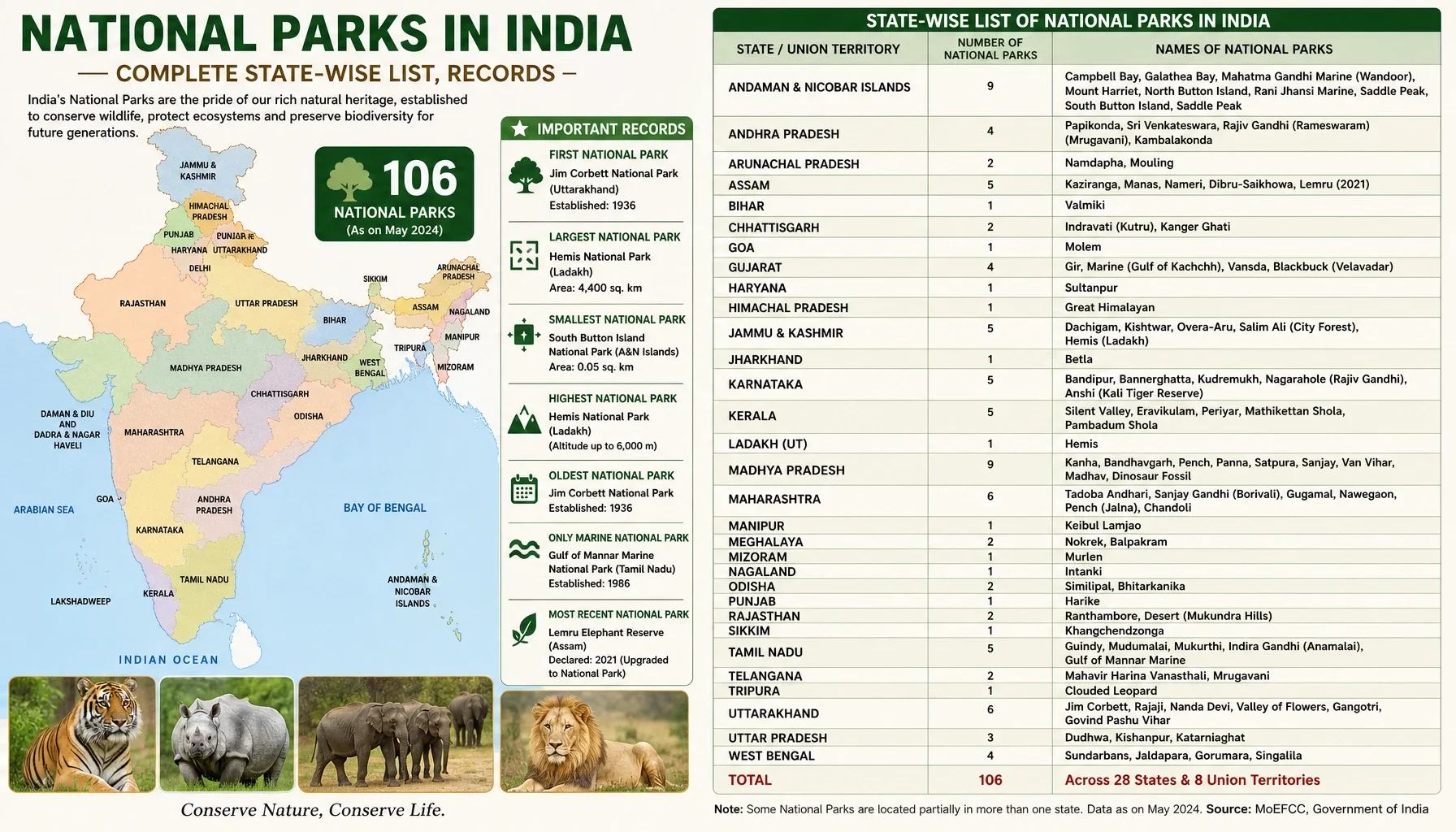
State-Wise List of National Parks in India
All 107 parks, with year of notification, approximate area and what each is best known for.
Andaman & Nicobar Islands (9)
| # | National Park | Year | Area (sq km) | Known For |
|---|---|---|---|---|
| 1 | Campbell Bay NP | 1992 | 426.23 | Great Nicobar rainforest, Nicobar megapode |
| 2 | Galathea Bay NP | 1992 | 110.00 | Giant leatherback turtle nesting |
| 3 | Mahatma Gandhi Marine NP (Wandoor) | 1983 | 281.50 | Coral reefs, glass-bottom boat zone |
| 4 | Middle Button Island NP | 1987 | 0.44 | Tiny uninhabited island ecosystem |
| 5 | Mount Harriett NP | 1987 | 46.62 | Highest peak of South Andaman |
| 6 | North Button Island NP | 1987 | 0.44 | Reef and mangrove fringe |
| 7 | Rani Jhansi Marine NP | 1996 | 256.14 | Ritchie's Archipelago corals, dugong |
| 8 | Saddle Peak NP | 1987 | 32.54 | Highest point in the Andamans |
| 9 | South Button Island NP | 1987 | 0.03 | Smallest national park in India |
Andhra Pradesh (3)
| # | National Park | Year | Area (sq km) | Known For |
|---|---|---|---|---|
| 1 | Papikonda NP | 2008 | 1013.00 | Eastern Ghats, Godavari gorge |
| 2 | Rajiv Gandhi (Rameswaram) NP | 2005 | 2.40 | Smallest park in the state |
| 3 | Sri Venkateswara NP | 1989 | 353.62 | Seshachalam hills, slender loris, red sanders |
Arunachal Pradesh (2)
| # | National Park | Year | Area (sq km) | Known For |
|---|---|---|---|---|
| 1 | Mouling NP | 1986 | 483.00 | Siang basin, takin, red panda |
| 2 | Namdapha NP | 1983 | 1808.00 | Only park with four big cats — tiger, leopard, snow leopard, clouded leopard |
Assam (8)
| # | National Park | Year | Area (sq km) | Known For |
|---|---|---|---|---|
| 1 | Dibru–Saikhowa NP | 1999 | 340.00 | Feral horses, wetland biosphere reserve |
| 2 | Kaziranga NP | 1974 | 859.00 | Two-thirds of the world's one-horned rhinos; UNESCO site |
| 3 | Manas NP | 1990 | 500.00 | UNESCO site; pygmy hog, golden langur |
| 4 | Nameri NP | 1998 | 200.00 | White-winged wood duck |
| 5 | Orang NP | 1999 | 78.81 | "Mini Kaziranga" on the north bank of the Brahmaputra |
| 6 | Raimona NP | 2021 | 422.00 | Golden langur habitat, Bodoland |
| 7 | Dihing Patkai NP | 2021 | 234.00 | Largest lowland rainforest patch in the region |
| 8 | Sikhna Jwhwlao NP | 2025 | — | Newest park in Assam |
Bihar (1)
| # | National Park | Year | Area (sq km) | Known For |
|---|---|---|---|---|
| 1 | Valmiki NP | 1989 | 335.65 | Only tiger reserve in Bihar, Gandak river belt |
Chhattisgarh (3)
| # | National Park | Year | Area (sq km) | Known For |
|---|---|---|---|---|
| 1 | Guru Ghasidas (Sanjay) NP | 1981 | 1440.71 | Proposed cheetah/tiger landscape |
| 2 | Indravati (Kutru) NP | 1982 | 1258.37 | Last wild buffalo population in the state |
| 3 | Kanger Valley NP | 1982 | 200.00 | Kutumsar limestone caves, Tirathgarh falls, bastar hill myna |
Goa (1)
| # | National Park | Year | Area (sq km) | Known For |
|---|---|---|---|---|
| 1 | Mollem NP | 1992 | 107.00 | Western Ghats, Dudhsagar falls |
Gujarat (4)
| # | National Park | Year | Area (sq km) | Known For |
|---|---|---|---|---|
| 1 | Vansda NP | 1979 | 23.99 | Dense moist deciduous teak forest |
| 2 | Blackbuck NP, Velavadar | 1976 | 34.53 | Blackbuck, wolf, harrier roost |
| 3 | Gir NP | 1975 | 258.71 | Only wild population of Asiatic lions |
| 4 | Marine NP, Gulf of Kachchh | 1982 | 162.89 | India's first marine national park |
Haryana (2)
| # | National Park | Year | Area (sq km) | Known For |
|---|---|---|---|---|
| 1 | Kalesar NP | 2003 | 46.82 | Shivalik sal forest |
| 2 | Sultanpur NP | 1989 | 1.43 | Ramsar wetland, migratory waterbirds |
Himachal Pradesh (5)
| # | National Park | Year | Area (sq km) | Known For |
|---|---|---|---|---|
| 1 | Great Himalayan NP | 1984 | 754.40 | UNESCO World Heritage site, western tragopan |
| 2 | Inderkilla NP | 2010 | 104.00 | Kullu high-altitude meadows |
| 3 | Khirganga NP | 2010 | 710.00 | Parvati valley catchment |
| 4 | Pin Valley NP | 1987 | 675.00 | Cold desert, snow leopard, Siberian ibex |
| 5 | Simbalbara NP | 2010 | 27.88 | Shivalik sal and goral habitat |
Jammu & Kashmir (3) and Ladakh (1)
| # | National Park | Year | Area (sq km) | Known For |
|---|---|---|---|---|
| 1 | City Forest (Salim Ali) NP, J&K | 1992 | 9.00 | Urban park on the Zabarwan foothills |
| 2 | Dachigam NP, J&K | 1981 | 141.00 | Only home of the hangul (Kashmir stag) |
| 3 | Kishtwar NP, J&K | 1981 | 425.00 | Musk deer, Himalayan brown bear |
| 4 | Hemis NP, Ladakh | 1981 | 3350.00 | Largest national park in India; snow leopard capital |
Jharkhand (1)
| # | National Park | Year | Area (sq km) | Known For |
|---|---|---|---|---|
| 1 | Betla NP | 1986 | 226.33 | Part of Palamau Tiger Reserve |
Karnataka (5)
| # | National Park | Year | Area (sq km) | Known For |
|---|---|---|---|---|
| 1 | Anshi NP (Kali) | 1987 | 417.34 | Black panther sightings, Western Ghats |
| 2 | Bandipur NP | 1974 | 874.20 | One of the first nine Project Tiger reserves |
| 3 | Bannerghatta NP | 1974 | 260.51 | Bengaluru's elephant corridor and biological park |
| 4 | Kudremukh NP | 1987 | 600.32 | Shola-grassland mosaic, lion-tailed macaque |
| 5 | Nagarhole NP (Rajiv Gandhi) | 1988 | 643.39 | Highest herbivore density in Asia; Nilgiri Biosphere Reserve |
Kerala (6)
| # | National Park | Year | Area (sq km) | Known For |
|---|---|---|---|---|
| 1 | Anamudi Shola NP | 2003 | 7.50 | High-altitude shola forest |
| 2 | Eravikulam NP | 1978 | 97.00 | Largest Nilgiri tahr population; Neelakurinji blooms |
| 3 | Mathikettan Shola NP | 2003 | 12.82 | Idukki shola patch |
| 4 | Pambadum Shola NP | 2003 | 1.32 | Smallest park in Kerala |
| 5 | Periyar NP | 1982 | 350.00 | Periyar lake, elephants, tiger reserve |
| 6 | Silent Valley NP | 1984 | 89.52 | Saved by the Save Silent Valley movement; lion-tailed macaque |
Madhya Pradesh (10)
| # | National Park | Year | Area (sq km) | Known For |
|---|---|---|---|---|
| 1 | Bandhavgarh NP | 1968 | 448.85 | Among the highest tiger densities in India |
| 2 | Dinosaur Fossils NP, Dhar | 2011 | 0.90 | Dinosaur egg and fossil site |
| 3 | Fossil NP, Mandla | 1983 | 0.27 | Plant fossils of the Gondwana era |
| 4 | Pench NP | 1975 | 292.85 | Setting of The Jungle Book landscape |
| 5 | Kanha NP | 1955 | 940.00 | Barasingha (hard-ground swamp deer) conservation success |
| 6 | Madhav NP | 1959 | 375.22 | Cheetah reintroduction landscape, Shivpuri |
| 7 | Panna NP | 1981 | 542.67 | Tiger reintroduction after local extinction; Ken river |
| 8 | Sanjay NP | 1981 | 466.88 | Contiguous with Guru Ghasidas |
| 9 | Satpura NP | 1981 | 585.17 | Walking safaris, Pachmarhi Biosphere Reserve |
| 10 | Van Vihar NP | 1979 | 4.45 | Bhopal; managed as a zoo-cum-park |
Note on the count: Many exam keys credit Madhya Pradesh with 9 parks because the tiny Dinosaur Fossils NP is sometimes excluded. If a question asks "which state has the most national parks," the accepted answer pairs Madhya Pradesh with Andaman & Nicobar Islands.
Maharashtra (6)
| # | National Park | Year | Area (sq km) | Known For |
|---|---|---|---|---|
| 1 | Chandoli NP | 2004 | 317.67 | Part of Sahyadri Tiger Reserve |
| 2 | Gugamal NP | 1975 | 361.28 | Core of Melghat Tiger Reserve |
| 3 | Nawegaon NP | 1975 | 133.88 | Birding lake, Vidarbha |
| 4 | Pench (Jawaharlal Nehru) NP | 1975 | 257.26 | Shared Pench landscape with MP |
| 5 | Sanjay Gandhi NP, Borivali | 1983 | 86.96 | Urban park inside Mumbai; Kanheri caves, leopards |
| 6 | Tadoba NP | 1955 | 116.55 | Oldest park in Maharashtra; tiger sightings |
Manipur (1)
| # | National Park | Year | Area (sq km) | Known For |
|---|---|---|---|---|
| 1 | Keibul Lamjao NP | 1977 | 40.00 | World's only floating national park (phumdis); sangai deer |
Meghalaya (2)
| # | National Park | Year | Area (sq km) | Known For |
|---|---|---|---|---|
| 1 | Balphakram NP | 1985 | 220.00 | Garo hills canyon, "land of spirits" |
| 2 | Nokrek Ridge NP | 1986 | 47.48 | Biosphere reserve; wild citrus gene pool |
Mizoram (2)
| # | National Park | Year | Area (sq km) | Known For |
|---|---|---|---|---|
| 1 | Murlen NP | 1991 | 100.00 | Semi-evergreen montane forest |
| 2 | Phawngpui Blue Mountain NP | 1992 | 50.00 | Highest peak of Mizoram |
Nagaland (1)
| # | National Park | Year | Area (sq km) | Known For |
|---|---|---|---|---|
| 1 | Intanki NP | 1993 | 202.02 | Hoolock gibbon, Peren district |
Odisha (2)
| # | National Park | Year | Area (sq km) | Known For |
|---|---|---|---|---|
| 1 | Bhitarkanika NP | 1988 | 145.00 | Largest saltwater crocodile population; mangroves |
| 2 | Simlipal NP | 2025 | 845.70 | Melanistic (black) tigers; India's newest national park |
Rajasthan (5)
| # | National Park | Year | Area (sq km) | Known For |
|---|---|---|---|---|
| 1 | Desert NP | 1992 | 3162.00 | Great Indian bustard; Thar ecosystem |
| 2 | Keoladeo Ghana NP | 1981 | 28.73 | UNESCO site and Ramsar wetland; birding |
| 3 | Mukundra Hills NP | 2006 | 200.54 | Chambal ravines tiger habitat |
| 4 | Ranthambore NP | 1980 | 282.00 | Fort inside the park; daytime tiger sightings |
| 5 | Sariska NP | 1992 | 273.80 | First reserve in the world to relocate tigers successfully |
Sikkim (1)
| # | National Park | Year | Area (sq km) | Known For |
|---|---|---|---|---|
| 1 | Khangchendzonga NP | 1977 | 1784.00 | India's only "mixed" UNESCO World Heritage site |
Tamil Nadu (5)
| # | National Park | Year | Area (sq km) | Known For |
|---|---|---|---|---|
| 1 | Guindy NP | 1976 | 2.82 | Inside Chennai city; blackbuck |
| 2 | Gulf of Mannar Marine NP | 1980 | 6.23 | Dugong, sea grass beds, 21 islands |
| 3 | Indira Gandhi (Annamalai) NP | 1989 | 117.10 | Anamalai tiger landscape |
| 4 | Mudumalai NP | 1990 | 103.23 | Elephant corridor with Bandipur and Wayanad |
| 5 | Mukurthi NP | 1990 | 78.46 | Nilgiri tahr, high-altitude grassland |
Telangana (3)
| # | National Park | Year | Area (sq km) | Known For |
|---|---|---|---|---|
| 1 | Kasu Brahmananda Reddy NP | 1994 | 1.43 | Urban forest in Hyderabad |
| 2 | Mahavir Harina Vanasthali NP | 1994 | 14.59 | Blackbuck park near Hyderabad |
| 3 | Mrugavani NP | 1994 | 3.60 | Deer and reptile habitat, Chilkur |
Tripura (2)
| # | National Park | Year | Area (sq km) | Known For |
|---|---|---|---|---|
| 1 | Clouded Leopard NP | 2007 | 5.08 | Sipahijola; clouded leopard, spectacled langur |
| 2 | Bison (Rajbari) NP | 2007 | 31.63 | Gaur habitat, South Tripura |
Uttar Pradesh (1)
| # | National Park | Year | Area (sq km) | Known For |
|---|---|---|---|---|
| 1 | Dudhwa NP | 1977 | 490.00 | Swamp deer and reintroduced rhinos; Terai belt |
Uttarakhand (6)
| # | National Park | Year | Area (sq km) | Known For |
|---|---|---|---|---|
| 1 | Jim Corbett NP | 1936 | 520.82 | India's first national park; birthplace of Project Tiger |
| 2 | Gangotri NP | 1989 | 2390.02 | Gaumukh glacier catchment; blue sheep |
| 3 | Govind NP | 1990 | 472.08 | Tons valley, snow leopard habitat |
| 4 | Nanda Devi NP | 1982 | 624.60 | UNESCO site with Valley of Flowers |
| 5 | Rajaji NP | 1983 | 820.00 | Elephants in the Shivalik-Terai corridor |
| 6 | Valley of Flowers NP | 1982 | 87.50 | Alpine flowering meadows; UNESCO site |
West Bengal (6)
| # | National Park | Year | Area (sq km) | Known For |
|---|---|---|---|---|
| 1 | Buxa NP | 1992 | 117.10 | Dooars elephant corridor to Bhutan |
| 2 | Gorumara NP | 1992 | 79.45 | One-horned rhino in North Bengal |
| 3 | Jaldapara NP | 2014 | 216.51 | Rhino grassland on the Torsa river |
| 4 | Neora Valley NP | 1986 | 159.89 | Red panda habitat |
| 5 | Singalila NP | 1986 | 78.60 | Sandakphu trek, red panda |
| 6 | Sundarban NP | 1984 | 1330.10 | UNESCO site; mangrove tigers, Royal Bengal tiger |
Records and Superlatives
Oldest national parks
| Rank | Park | Year | State |
|---|---|---|---|
| 1 | Jim Corbett (Hailey) NP | 1936 | Uttarakhand |
| 2 | Kanha NP | 1955 | Madhya Pradesh |
| 3 | Tadoba NP | 1955 | Maharashtra |
| 4 | Madhav NP | 1959 | Madhya Pradesh |
| 5 | Bandhavgarh NP | 1968 | Madhya Pradesh |
Before 1970, India had only five national parks. The Wild Life (Protection) Act of 1972 and Project Tiger triggered the expansion that followed.
Largest national parks
| Rank | Park | Area (sq km) | State/UT |
|---|---|---|---|
| 1 | Hemis | 3,350 | Ladakh |
| 2 | Desert | 3,162 | Rajasthan |
| 3 | Gangotri | 2,390 | Uttarakhand |
| 4 | Namdapha | 1,808 | Arunachal Pradesh |
| 5 | Khangchendzonga | 1,784 | Sikkim |
| 6 | Guru Ghasidas | 1,441 | Chhattisgarh |
| 7 | Sundarban | 1,330 | West Bengal |
| 8 | Indravati | 1,258 | Chhattisgarh |
| 9 | Papikonda | 1,013 | Andhra Pradesh |
| 10 | Kanha | 940 | Madhya Pradesh |
Smallest national parks
| Rank | Park | Area (sq km) | State/UT |
|---|---|---|---|
| 1 | South Button Island | 0.03 | Andaman & Nicobar |
| 2 | Fossil NP, Mandla | 0.27 | Madhya Pradesh |
| 3 | Middle Button Island | 0.44 | Andaman & Nicobar |
| 4 | North Button Island | 0.44 | Andaman & Nicobar |
| 5 | Dinosaur Fossils NP | 0.90 | Madhya Pradesh |
| 6 | Pambadum Shola | 1.32 | Kerala |
Newest national parks
| Park | Year | State |
|---|---|---|
| Simlipal NP | 2025 | Odisha |
| Sikhna Jwhwlao NP | 2025 | Assam |
| Dihing Patkai NP | 2021 | Assam |
| Raimona NP | 2021 | Assam |
| Jaldapara NP | 2014 | West Bengal |
Thematic Groupings Worth Revising
Marine national parks (4): Gulf of Kachchh (Gujarat, the first), Gulf of Mannar (Tamil Nadu), Mahatma Gandhi Marine (A&N), Rani Jhansi Marine (A&N).
Cold-desert / high-altitude parks: Hemis, Pin Valley, Gangotri, Govind, Nanda Devi, Khangchendzonga.
Fossil parks (2): Fossil NP, Mandla and Dinosaur Fossils NP, Dhar — both in Madhya Pradesh, both among the smallest in India.
Parks inside cities: Sanjay Gandhi NP (Mumbai), Guindy NP (Chennai), Kasu Brahmananda Reddy NP (Hyderabad), Van Vihar NP (Bhopal), City Forest NP (Srinagar), Bannerghatta NP (Bengaluru).
National parks in the UNESCO World Heritage list: Kaziranga, Manas, Keoladeo, Nanda Devi & Valley of Flowers, Great Himalayan NP, Sundarbans, and Khangchendzonga (the only mixed natural-and-cultural site in India).
Single-park states: Bihar, Goa, Jharkhand, Manipur, Nagaland, Sikkim, Uttar Pradesh — and Ladakh among the UTs.
States with no national park: Punjab, Delhi (NCT has none notified) and several smaller UTs including Chandigarh, Puducherry, Dadra & Nagar Haveli and Daman & Diu, and Lakshadweep.
Memory Tricks
- 1936 → Corbett — India's first, and remember it was renamed twice (Hailey → Ramganga → Corbett).
- Hemis is highest and largest; South Button is smallest — the two extremes are both in remote territory, one Himalayan, one island.
- "Three A's for the North East rhino belt": Assam has Kaziranga, Manas, Orang — all rhino habitats.
- Kerala's four "Sholas": Anamudi, Mathikettan, Pambadum, plus Silent Valley — all notified in the shola-grassland zone, three of them in 2003.
- Telangana's trio (1994): Kasu Brahmananda Reddy, Mahavir Harina Vanasthali, Mrugavani — all notified in the same year, all small and near Hyderabad.
- Floating = Keibul Lamjao (Manipur), Floating vegetation = phumdi, Deer = sangai.
Practice Questions
1. Which national park is the only habitat of the hangul? a) Kishtwar b) Dachigam c) Hemis d) City Forest Answer: (b) Dachigam
2. The Wild Life (Protection) Act came into force in which year? a) 1970 b) 1972 c) 1980 d) 1986 Answer: (b) 1972
3. Keibul Lamjao National Park is associated with: a) Nilgiri tahr b) Sangai deer c) Golden langur d) Pygmy hog Answer: (b) Sangai deer
4. Which is India's first marine national park? a) Gulf of Mannar b) Rani Jhansi Marine c) Gulf of Kachchh d) Wandoor Answer: (c) Gulf of Kachchh
5. Silent Valley National Park is located in: a) Karnataka b) Tamil Nadu c) Kerala d) Goa Answer: (c) Kerala
6. The boundaries of a national park can be altered only through: a) An order of the Chief Wildlife Warden b) A resolution of the State Legislature c) A notification by the district collector d) An order of the National Board for Wildlife Answer: (b) A resolution of the State Legislature
7. Namdapha National Park is notable because it harbours: a) Four big cat species b) The largest rhino population c) India's only lions d) Melanistic tigers Answer: (a) Four big cat species
8. Which national park in India is a mixed UNESCO World Heritage Site? a) Sundarbans b) Nanda Devi c) Khangchendzonga d) Manas Answer: (c) Khangchendzonga
9. Bhitarkanika National Park is best known for: a) Saltwater crocodiles b) Snow leopards c) Great Indian bustard d) Barasingha Answer: (a) Saltwater crocodiles
10. Under IUCN classification, Indian national parks fall under: a) Category I b) Category II c) Category IV d) Category VI Answer: (b) Category II
Frequently Asked Questions
How many national parks are there in India in 2026? India has 107 national parks covering roughly 44,403 sq km, about 1.35% of the country's geographical area. The WII national wildlife database still shows 106, since the most recent notifications are yet to be reflected there.
Which is the largest national park in India? Hemis National Park in Ladakh, spread over about 3,350 sq km. It is also one of the best places in the world to spot snow leopards.
Which is the smallest national park in India? South Button Island National Park in the Andaman & Nicobar Islands, at roughly 0.03 sq km.
Which is the oldest national park in India? Jim Corbett National Park in Uttarakhand, notified in 1936 as Hailey National Park.
Which is the newest national park in India? Simlipal in Odisha, notified in 2025, along with Sikhna Jwhwlao in Assam the same year.
Which state has the most national parks? Madhya Pradesh, tied with the Andaman & Nicobar Islands.
What is the main difference between a national park and a wildlife sanctuary? A national park has fully settled rights and permits no human activity or grazing, and its boundaries can only be changed by the State Legislature. A sanctuary can allow certain regulated rights and can later be upgraded to a national park.
Which states in India have no national park? Punjab and Delhi have none, along with UTs such as Chandigarh, Puducherry, Lakshadweep, and Dadra & Nagar Haveli and Daman & Diu.